Course Code · 2026 to present
An AI-native consumer product.
Built solo with an AI co-founder, as a deliberate experiment. No Figma. No wireframes. No mocks. Just brief, prompt, judge, ship. 18K+ courses indexed. 5.2K users in 30 days. 100% organic growth. And one question driving all of it: what's load-bearing, and what's anxious?
Role
Founder · Product · Design
Duration
10 weeks
Team
One human, one AI
Status
Live · Phase 1 shipped
Live, as of May 2026
5.2K
Active users (30 days)
18K+
Courses indexed
+96%
MoM user growth
$0
Paid acquisition spend
By the way
0 Figma files. 0 wireframes. 0 mocks. 0 prototypes. The artifact stack collapsed by design.
The experiment
What's load-bearing?
What's anxious?
Course Code is a real consumer product. It is also a deliberate stress test on the design discipline. How far could AI take a design role if I only stepped in for judgment?
The hypothesis
AI can execute.
Taste cannot be delegated.
The rule was specific. No Figma. No wireframes. No mocks. No prototypes. No spec docs translating intent for engineers. Brief, prompt, judge, ship.
The test: which artifacts in the design process are load-bearing, the ones the design itself depends on, and which are anxious, the ones we produced to protect against a handoff failure that hadn't happened yet?
The verdict is belowto the right.
Anxious
Produced to defend against a handoff failure. Translation insurance between stations.
What collapsed
- 01 Wireframes
- 02 Hi-fi mocks
- 03 Prototypes
- 04 Handoff specs
- 05 Mock-explainer decks
These existed because each station didn't trust the next. AI dissolves the handoff. The defenses can come down.
Load-bearing
The design itself depends on these. They cannot be delegated, automated, or rushed.
What stayed
- 01
Taste.
Knowing which one of ninety-nine ships. The years-of-staring-at-pixels skill.
- 02
Judgment.
The calls about what the product is, who it is for, and what it refuses to be.
- 03
The brief.
The new artifact that carries intent directly into the build. The brief IS the design.
Everything else compresses. These three got more important, not less.
The cost
AI collapsed the stack.
It did not collapse the work.
Course Code is live. It is not pixel perfect. The screenshots on this page have spacing I would still fix, copy I would still rewrite, edge cases I would still polish. What you are seeing is the result of hundreds of hours of judgment calls AI could not make for me.
The artifact stack existed because each station distrusted the next. Wireframes protected designers from their own future selves. Mocks protected engineering from interpretive ambiguity. Specs protected the build from edge cases. Every artifact was insurance against a handoff failure. AI dissolves most of those handoffs by carrying intent directly into code. The defenses become unnecessary. The irreducible part of the work steps forward.
Every prompt landed because the brief was tight. Every output shipped because I rejected the ninety-nine that were not good enough. Every screen I kept earned its spot against three I threw out. AI gave me execution at the speed of one. Taste did the rest.
The new workflow does not make designers less important. It makes us more important. The work that is left is the hardest work designers do.
What does not collapse
Taste.
Knowing which one of the ninety-nine ships, and refusing the rest.
Judgment.
The hundred small calls about what this product is, who it is for, and what it refuses to be.
Everything else can compress. These two cannot be delegated, automated, or rushed.
That's the thesis. Course Code is the proof.
What follows is the product itself. The problem it solves, the insight that shaped it, the bet it ran on, what shipped, and what the numbers say.
Women face a quiet, universal golf problem. Showing up at a new course without knowing the dress code. The rules are real, enforced, and the difference between welcome and turned away at the bag drop. But they're buried in PDFs, missing from websites, and never written from a woman's perspective.
The opportunity wasn't "here are the rules." It was: here's how to show up as yourself, within the rules, on every course you'll play. Utility earns the right for identity. The lookup is the hook; the Style Planner is the product.
"Know before you go."
Conventional path: hire a developer, build for six months, launch. Course Code went different. A solo founder with the right AI infrastructure can operate at the output level of a small team. Not AI as a tool. AI as a co-founder with authority.
The product
Built and shipped.
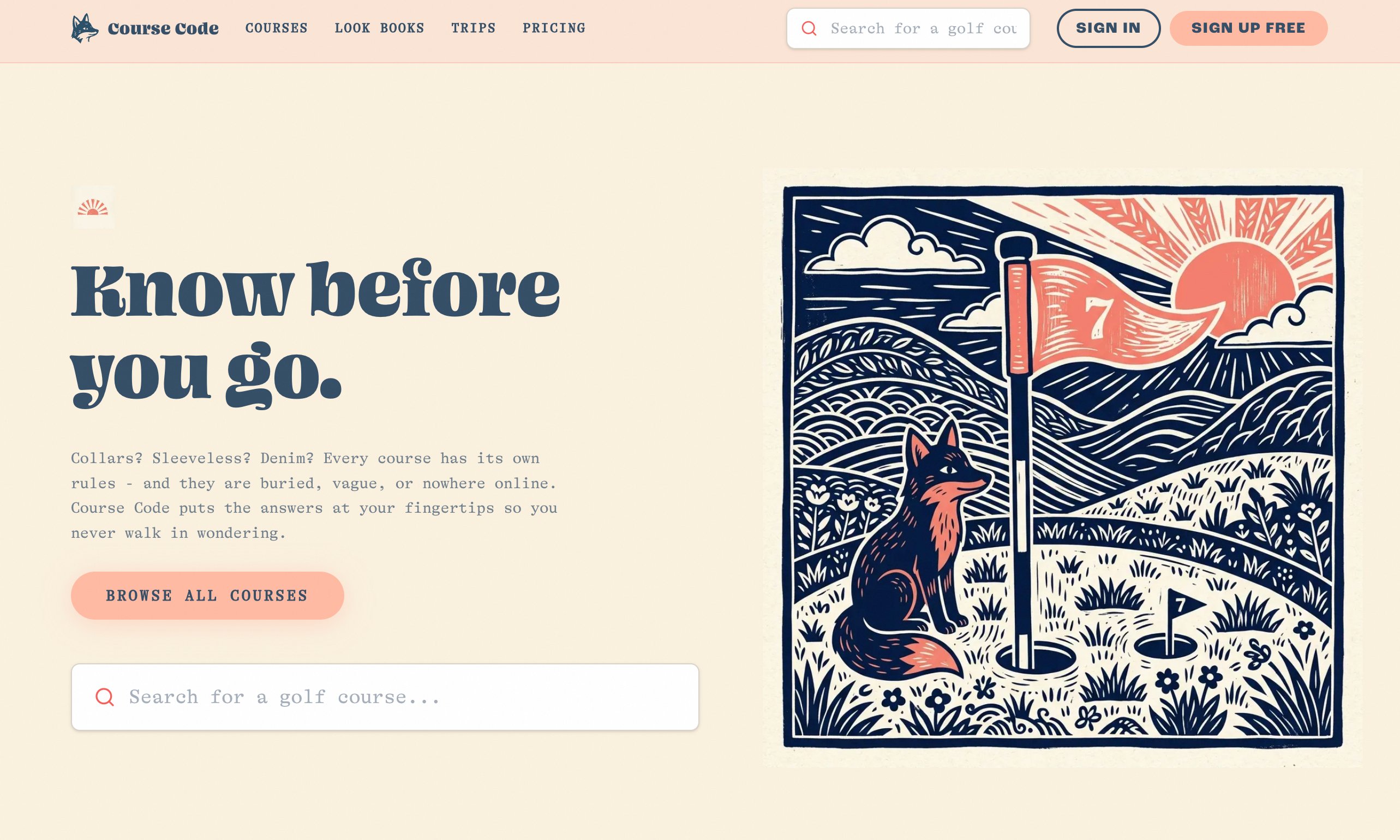
Marketing home · Know before you go
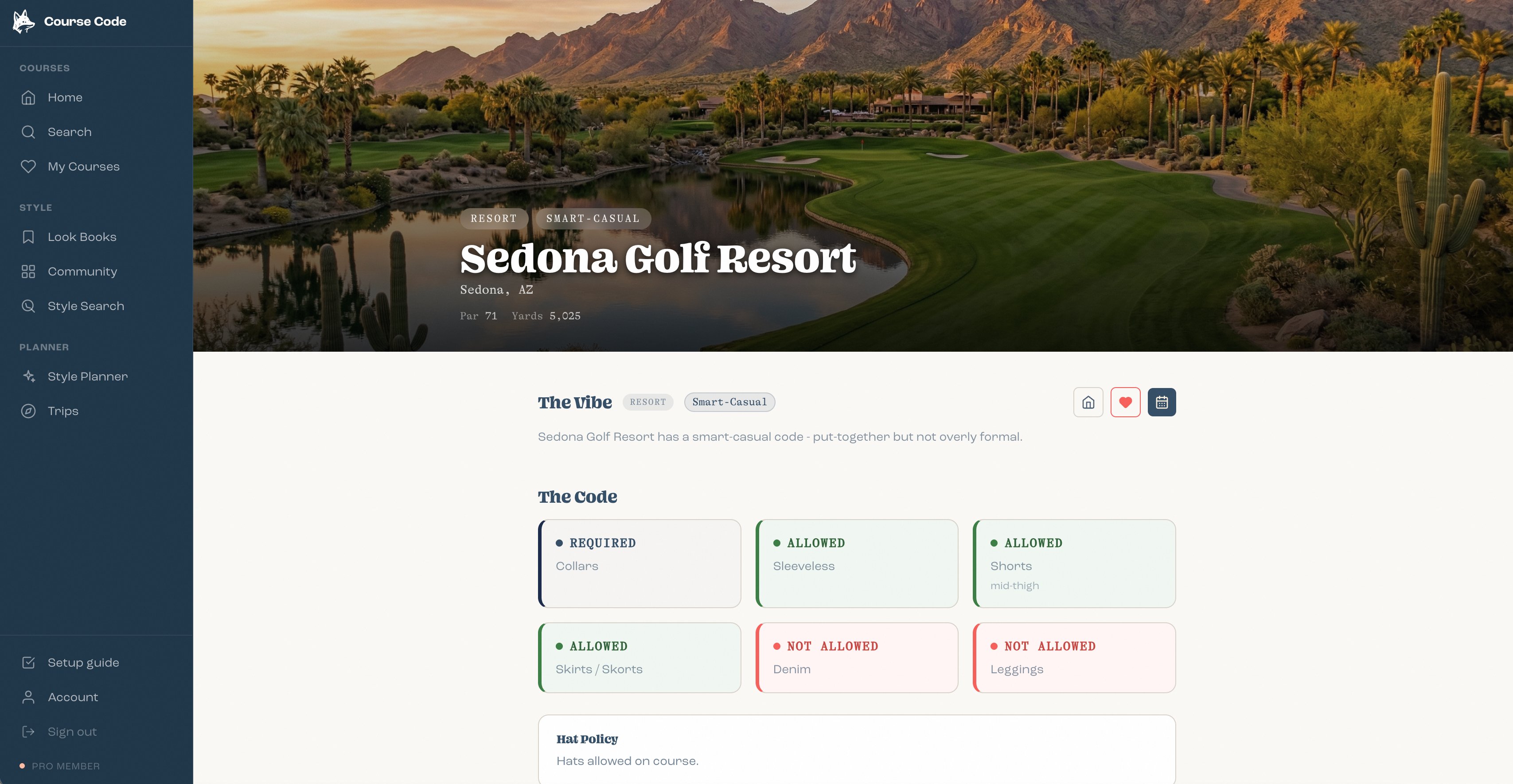
Course detail · The Vibe + The Code + What to Wear
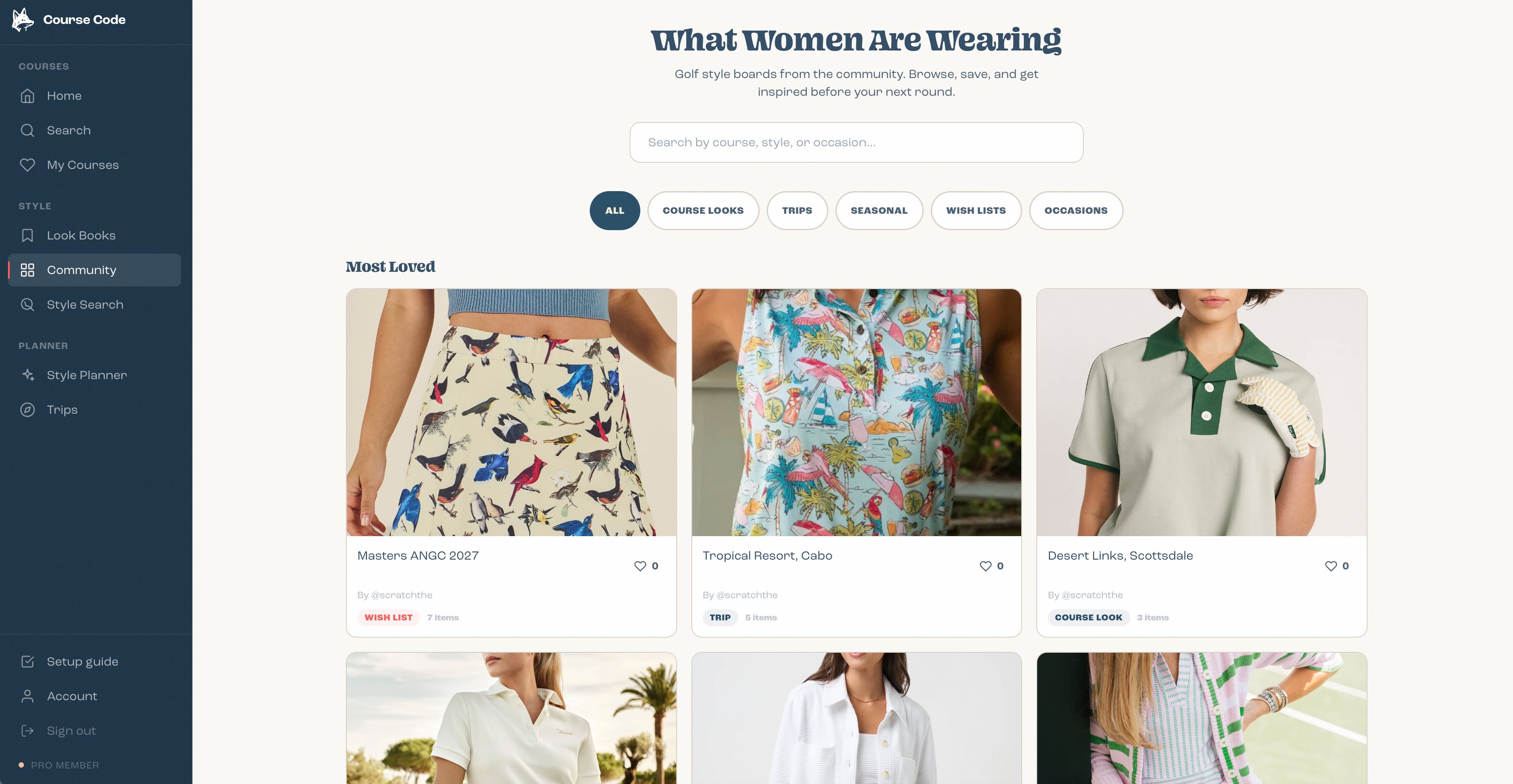
Community · What women are wearing
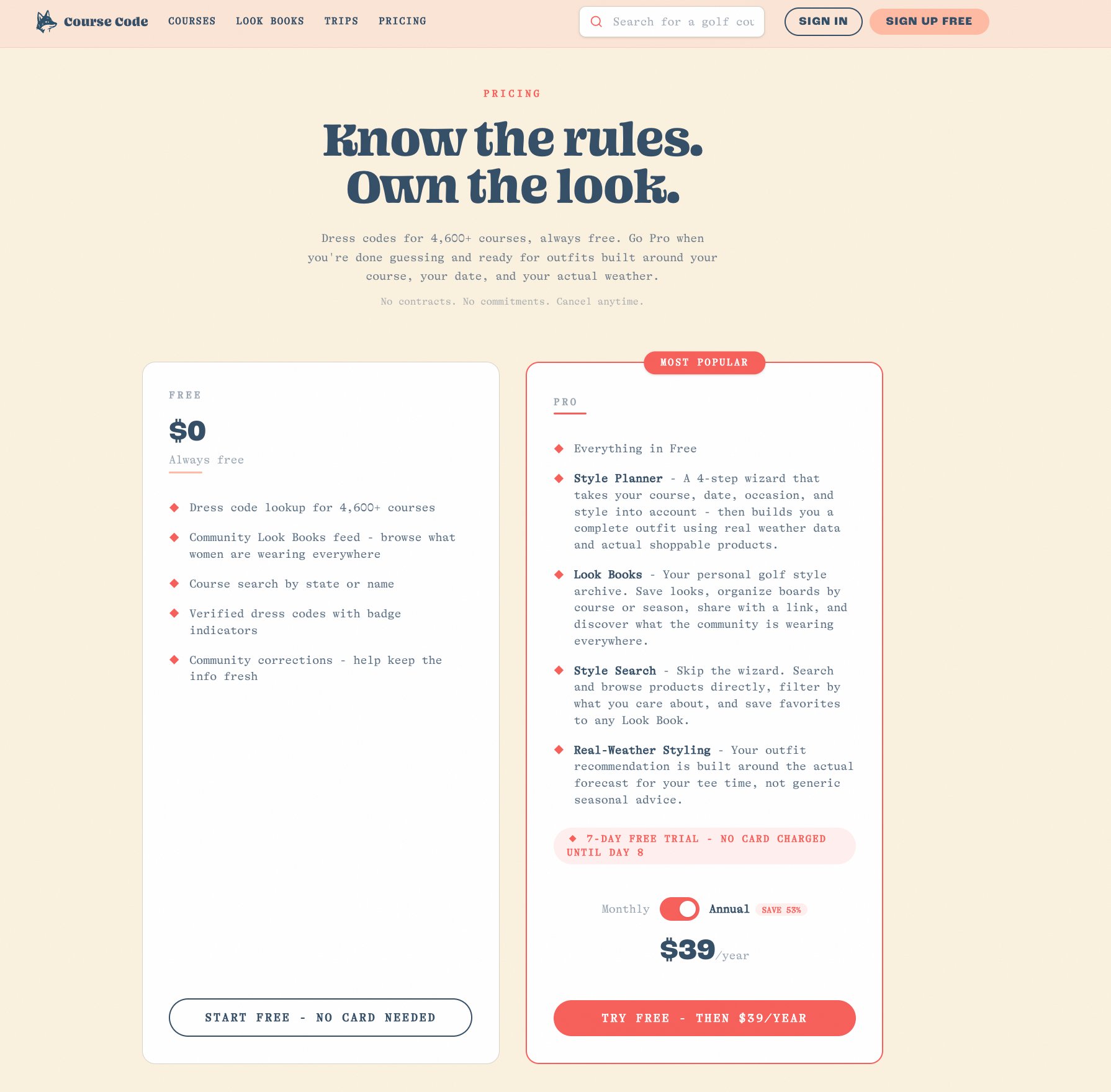
Pricing · Know the rules. Own the look.
Free + Pro
Utility for everyone, intelligence for Pro.
Free
$0
Always free
- ◆ Dress code lookup, 18K+ courses, all 50 states
- ◆ Course vibe ratings: casual, smart casual, traditional, strict
- ◆ Policy details: collars, sleeveless, denim, leggings, hats
- ◆ Public Look Books, shareable by link, viral loop
- ◆ Verified courses with badge indicators
Pro
$39/yr
$6.99/mo · 7-day free trial
- ◆ Everything in Free
- ◆ Style Planner. 4-step wizard. Course + date + occasion + style with real-weather data.
- ◆ Look Books. Personal golf style archive. Save, organize, share, discover.
- ◆ Style Search. Search shoppable products. Filter, save to Look Books.
- ◆ Real-weather styling. Forecast for your tee time, not generic seasonal advice.
The stack
Modern, fast, and AI-native at every layer.
Next.js 16
React 19, TypeScript
Tailwind CSS 4
Design tokens, utilities
Vercel
Auto-deploy under 2 min
Supabase
Postgres + Auth + RLS
Stripe
Pro plan, trial, webhooks
PostHog
Behavioral analytics
Sentry
Error monitoring
Klaviyo
4-email nurture sequence
OpenClaw + Claude
AI co-founder runtime
@anthropic-ai/sdk
Production dependency
Linear
Source of truth for work
n8n
Self-hosted automation
The numbers
Growth is working. Conversion is the next problem.
01 · Growth
The organic story.
18K+
Courses indexed
5.2K
Active users · 30 days
+96%
MoM user growth
$0
Paid acquisition spend
02 · Acquisition
The funnel is filling.
339
Total accounts
239
New accounts · 30 days
76
New accounts · 7 days
Up
Sign-up rate accelerating
03 · Conversion
The next problem to solve.
5
Pro subscribers ever
0
Active subscribers today
1%
Upgrade-prompt CTR
Next
Funnel rework underway
The growth story is real. The conversion story isn't yet. The upgrade prompt shows 101 times for every 1 click. A message, timing, or placement problem that needs a rebuild, not a tweak. Diagnosing the funnel, then fixing the prompt, is the next milestone. Founder mode means owning what's working and what isn't.
Source: Supabase + PostHog + Stripe + Google Search Console, live data May 27, 2026.
Organic, by design
The product is its own marketing.
64.6K
Impressions
Google search · last 28 days · up 47%
4.92K
Clicks
Google search · last 28 days · up 50%
52K
Pageviews
Last 7 days · 3.3K sessions
0
Paid spend
No ads · no influencers · no PR
18K+ indexed pages, written for women searching real golf course names with real dress code questions. The course directory is the SEO strategy. Every page exists because a woman is looking for that information at that moment. Utility scales when the product solves a search query that nobody else is answering.
What the experiment taught
Taste leads. Everything else compresses.
Taste is doing more work than ever.
AI hands you 100 options at the speed of one. The job is knowing which one ships and which 99 die. That is not a tool skill. That is a years-of-staring-at-pixels skill. The skill that compounds is editorial judgment. The one thing that cannot be delegated.
The brief is the design.
80% of the work is the spec. Once the spec was right, the output was 90% right on the first try. The traditional design process was mostly translation: intent into mocks, mocks into specs, specs into code. The brief now does all of that work directly.
Authority beats access.
Anyone can prompt the same model. The differentiator is what you tell it to do, and what you refuse to ship. The senior move is the no, said 99 times before the yes.
The artifact stack collapsed.
Wireframe, mock, prototype, spec, handoff. All compressed into one prompt-and-judge loop. Fidelity stopped being a phase. The assembly line existed because we didn't trust the next station. AI exposed which parts of that anxiety were load-bearing.
The meta-point
The artifact stack collapsed.
Taste and judgment did not.
Course Code is a product. The experiment behind it is a position on the design discipline. Most of the artifact stack we trained a generation of designers to build, the wireframes, mocks, prototypes, spec docs, handoff files, existed because we did not trust the next station to build the right thing. AI did not just make those artifacts faster. It made the stack honest.
What did not collapse is taste and judgment. The one hundred small calls about which screen earns its place, what the product refuses to be, which ninety-nine outputs die so the right one ships. Those calls cost me hundreds of hours on Course Code. AI could not make any of them for me.
That is the case for designers in 2026. We are not less important. We are more important. The discipline got harder because what is left of the work is the part only a trained eye can do. The senior move is deleting the anxious artifacts and protecting the irreducible ones.